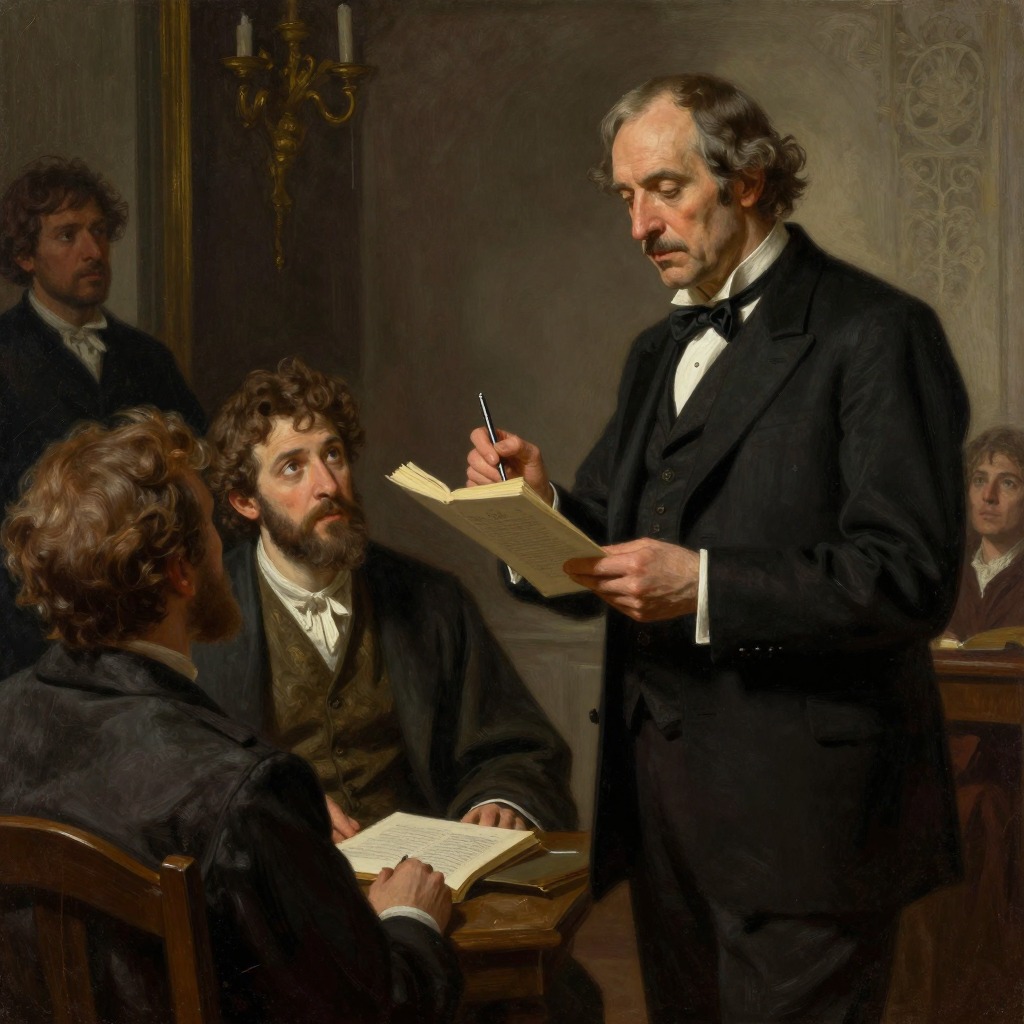
The judgment of men
In Albert Camus's The Fall, the judgment of men is the inescapable, relentless moral scrutiny that human beings impose on one another, a force that Jean-Baptiste Clamence comes to see as more immediate and terrifying than any divine Last Judgment. It is the engine of his fall and the foundation of his final, paradoxical profession as a judge-penitent. Clamence's entire monologue is a response to the discovery that he is not above judgment but subject to it, and that the world is filled with judges eager to condemn.
The Inescapable Vocation for Judgment
Clamence's awakening to the judgment of men begins when he realizes that his own vulnerability invites the judgment of others. He observes that "the idea that comes most naturally to man, as if from his very nature, is the idea of his innocence," yet this very claim to innocence provokes others to judge. He notes that people "hasten to judge in order not to be judged themselves," revealing a universal, self-protective reflex. This dynamic is not limited to courts of law; it pervades all human relations. Clamence himself, once a lawyer who "instinctive[ly] scorn[ed] for judges in general," discovers that he too is a judge at heart. After the motorcycle confrontation, he admits that when threatened, he became "not only a judge in turn but even more: an irascible master who wanted, regardless of all laws, to strike down the offender." The judgment of men is thus a reciprocal, escalating cycle: everyone judges to avoid being judged, and no one is innocent.
The Weight of Human Judgment vs. Divine Judgment
Clamence explicitly contrasts the judgment of men with the Last Judgment, finding the former far more oppressive. He declares, "I shall wait for it [the Last Judgment] resolutely, for I have known what is worse, the judgment of men. For them, no extenuating circumstances; even the good intention is ascribed to crime." Human judgment offers no mercy, no appeal, and no finality. It is a constant, diffuse threat that follows him everywhere. He describes the moment he became aware of this: "the circle of which I was the center broke and they lined up in a row as on the judge's bench." The judgment of men is not a single event but a perpetual state of being watched, evaluated, and condemned. This leads him to his central insight: "Don't wait for the Last Judgment. It takes place every day." The divine judgment is postponed and abstract; human judgment is immediate and concrete.
The Judge-Penitent's Solution: Preemptive Self-Judgment
To escape the judgment of men, Clamence devises the profession of judge-penitent. His method is to preemptively accuse himself of every possible failing, thereby disarming his accusers and gaining the right to judge them in turn. He explains: "I accuse myself up and down. ... I mingle what concerns me and what concerns others. I choose the features we have in common ... With all that I construct a portrait which is the image of all and of no one." This portrait becomes a mirror: "The portrait I hold out to my contemporaries becomes a mirror." By confessing his own guilt, he forces others to recognize their own, and by judging himself, he seizes the authority to judge them. He states his principle: "No excuses ever, for anyone; that's my principle at the outset. I deny the good intention, the respectable mistake, the indiscretion, the extenuating circumstance." This universal condemnation, he believes, thins out the weight of his own guilt. The judgment of men is not escaped but mastered: he becomes the judge who condemns everyone, including himself, thereby achieving a terrible, lonely sovereignty.
The Failure of Escape and the Cry of the Drowning Woman
The judgment of men is ultimately inescapable because it is internalized. Clamence's pivotal memory—the suicide of a young woman he failed to save from the Seine—becomes the permanent, accusing cry that he cannot silence. He recalls: "I heard the sound ... of a body striking the water. ... I wanted to run and yet didn't stir. ... I informed no one." This act of omission becomes the core of his guilt, a secret that makes him vulnerable to the judgment of others. Years later, on a ship, he sees a black speck in the ocean and realizes "that cry which had sounded over the Seine behind me years before had never ceased, carried by the river to the waters of the Channel, to travel throughout the world." The judgment of men is not merely external; it is the voice of his own conscience, the memory of his failure. He even imagines his interlocutor, a fellow Parisian lawyer, uttering the words that haunt him: "O young woman, throw yourself into the water again so that I may a second time have the chance of saving both of us!" The judgment of men is the echo of a single, irreversible moment of cowardice, amplified into a universal condemnation.